Silicon Carbide Magnetometer (SiCMag)
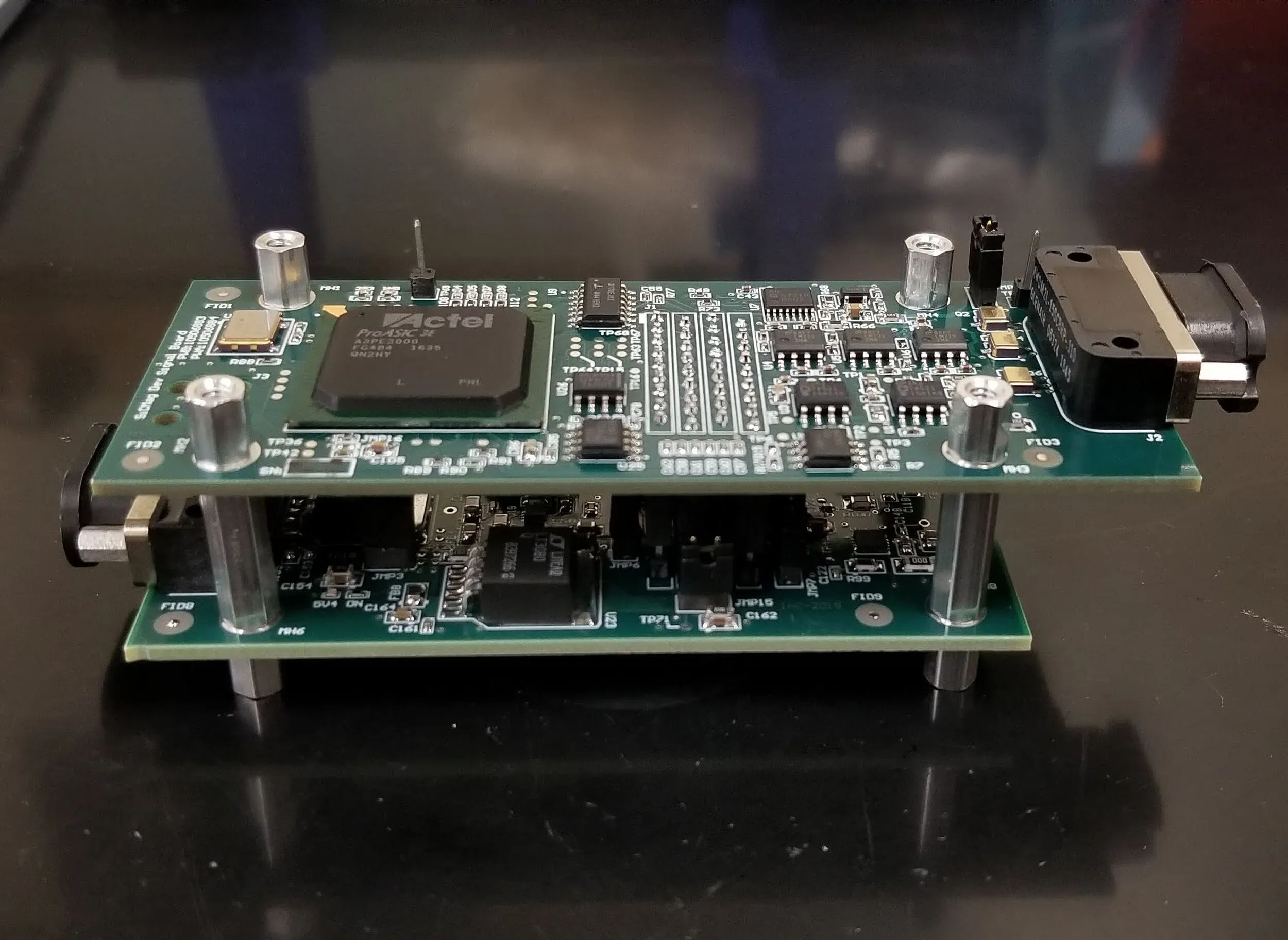
Flight-like prototype electronics for a compact silicon-carbide magnetometer intended to sense planetary magnetic fields.
Overview
The Silicon Carbide Magnetometer (SiCMag) concept uses atomic-scale defects in a silicon-carbide semiconductor to sense magnetic fields. The team was developing a smaller, less complex instrument architecture for planetary science, with potential use on very small spacecraft. Matching the sensitivity of established magnetometers was a research goal, not a demonstrated result in the available project material.
Approach
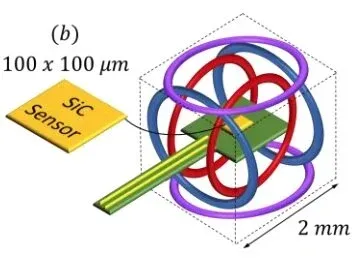
The proposed sensor places a silicon-carbide diode within three orthogonal sets of Helmholtz coils. Each coil axis modulates the ambient field at a different frequency. A high-gain amplifier conditions the diode current, converters digitize it, and an FPGA demodulates the frequency-multiplexed signal to recover three field components.
My Contribution
I joined while SiCMag was still a concept and served as lead electrical engineer for its flight-like demonstration prototype. Working from the science team’s measurement needs, I wrote electronics requirements and planned the electrical architecture. I captured new schematics, simulated critical circuits in LTspice, and designed PCB layouts, electrical harnesses, and mechanical mounting interfaces.
I designed the electronics for lab configurability, so the team could adjust and evaluate the instrument during development. I selected commercial components with flight-equivalent options where available, keeping a path open for later spaceflight hardware. I also wrote assembly and test procedures, assembled and tested prototype electronics, and created the initial VHDL framework for the FPGA’s signal-processing implementation.
Results
I delivered the flight-like prototype electronics for continued SiCMag development. The assembled and tested hardware, together with the initial FPGA framework and assembly documentation, gave the team a configurable starting point for further instrument integration and performance testing.