AV Discomfort Detection Model
Production ML models that detect hard-braking and oscillation events in autonomous-vehicle telemetry.
Overview
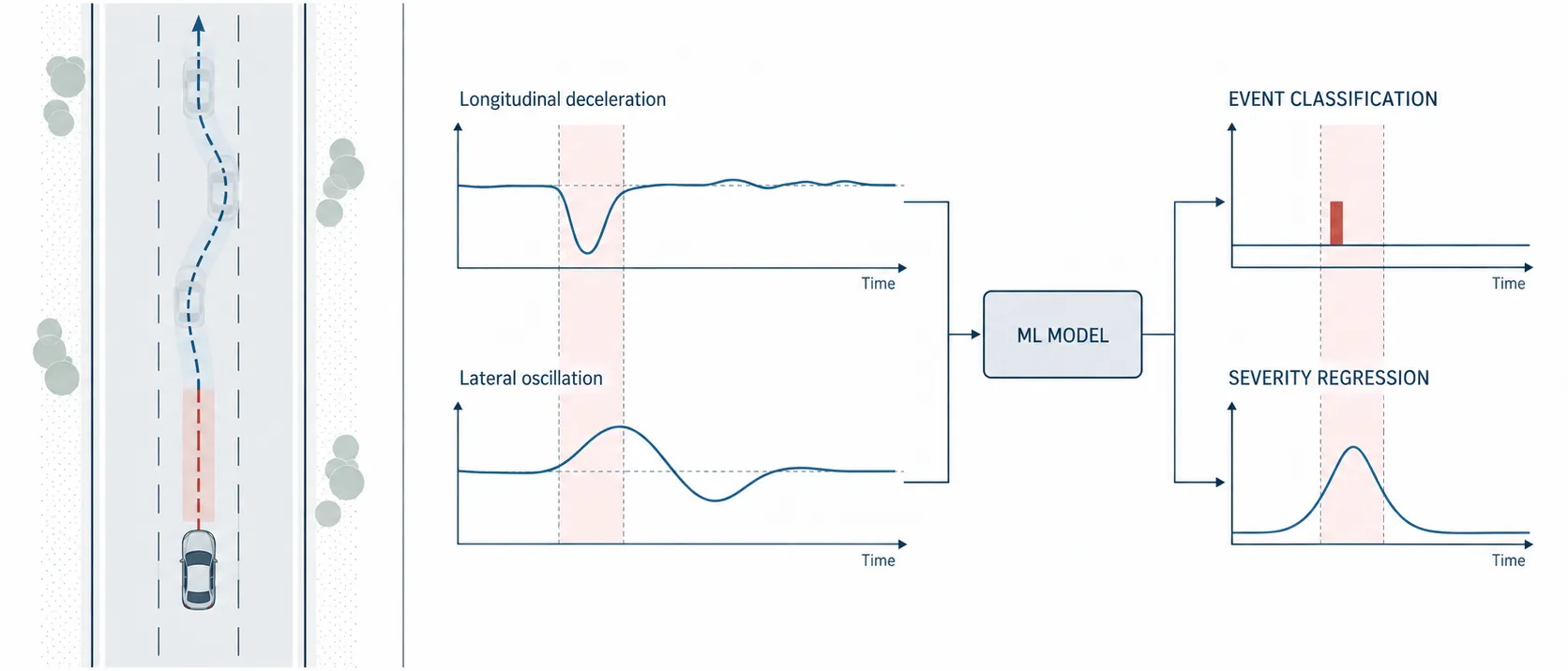
Autonomous-vehicle teams use Discomfort Detection to identify events such as hard braking and oscillation from driving telemetry. These detections also feed metrics used to assess driving quality over time. The models needed to recognize high-severity events accurately while remaining practical to run on vehicle.
My Contribution
I accelerated the training pipeline by parallelizing feature generation, reducing that step to about 25% of its previous runtime. I compared temporal feature extractors and selected a compact tsfresh_basic18 feature set that outperformed the previous ROCKET-based representation in high-severity event experiments and could be computed on vehicle. I trained separate hard-braking and oscillation models, implemented their feature calculations in C++, and helped convert the models to TorchScript for the AV stack. I also built comparison and monitoring tools to check on-vehicle behavior against off-vehicle predictions.
After taking ownership of the ML Comfort Metrics pipeline, I restored it following an upstream data-channel change and developed a replacement detector using approximately 1.5 years of newer driving data. I evaluated XGBoost classification and regression approaches and added temporal peak-finding and filtering to reduce false detections.
Results
The on-vehicle models were released as v1.0.0 in 2024. The later detector was released into the production metrics pipeline in 2025 and improved accuracy by approximately 8–10 percentage points over the previous production model. The deployment tooling, model records, and monitoring work made subsequent updates easier to trace and validate.